
The "Dropping Nonbinary Rates" Paper Is More Ominous Than It Looks
which is worse, actually


You might have seen the Heterodox report going around, where the anti-woke Eric Kaufmann looks at a bunch of surveys and finds that nonbinary rates at universities are dropping! The fad is passing!
I’m default suspicious of any research that seems politically motivated, but you shouldn’t let suspicion get in the way of facts, and the paper seems pretty good. It compiles a few big-n surveys done at universities, and finds this:
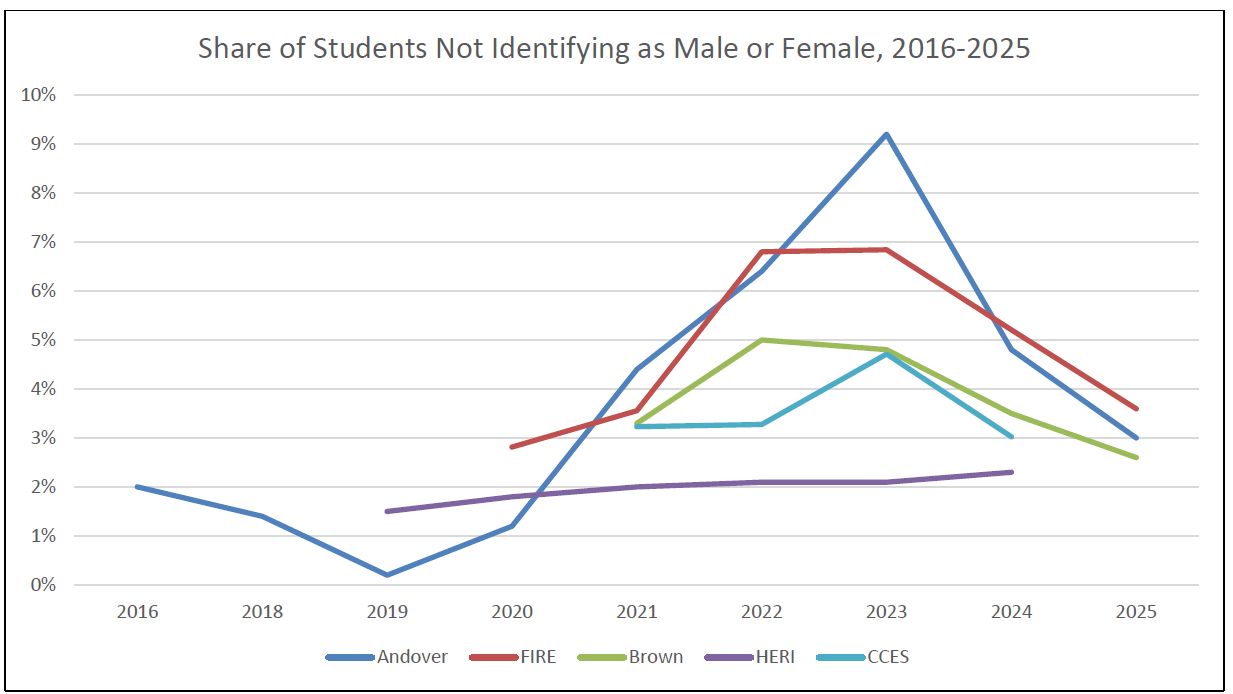
One big drawback with these surveys is that their gender questions are some variations on:
Are you male, female, or neither of those?
Transmen and transwomen often pick male or female, as they tend to avoid answering anything other than standard man-woman categories, so these surveys are capturing primarily nonbinary/other data, not trans data.
But I have data! My sample now is ~850,000 people, median age 22, drawn from many corners of the internet (viral on multiple platforms, very good google SEO). And I ask way more specific questions about gender! What trends in gender identification do I find in my data? Does my data match up with the findings of college trends?
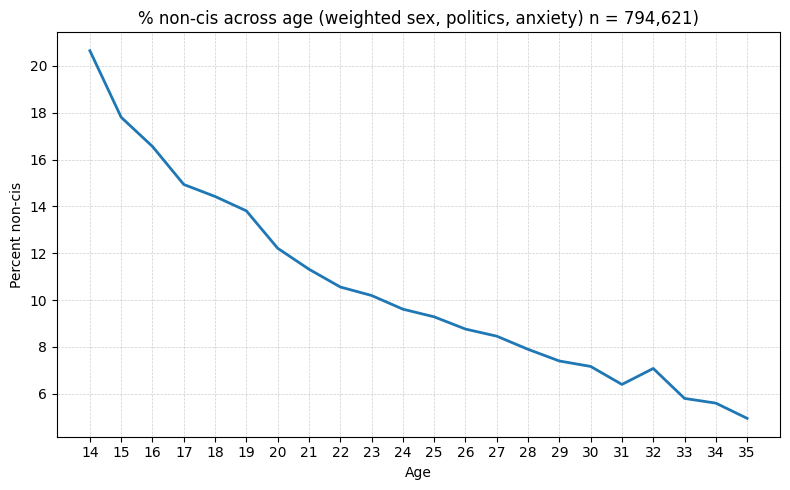
I don’t find a dip. Weird.
My non-cis category here includes both nonbinary and trans, so will be a higher number than the surveys Eric compiled. Maybe if I split this out a bit more?
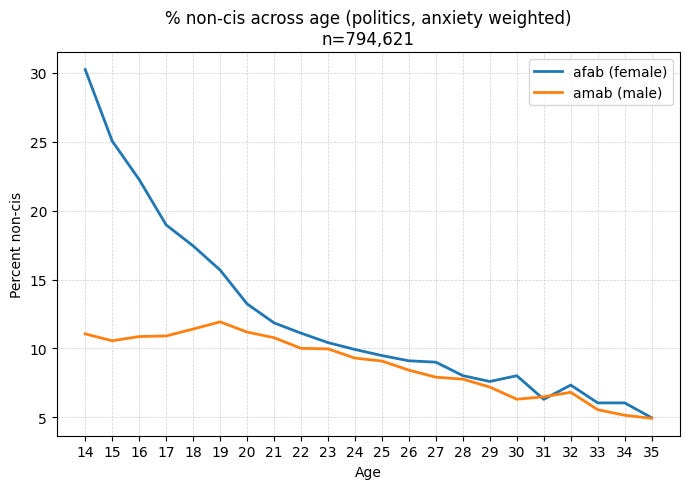
I am seeing a slight drop in rates - but only among people born male.
The non-cis rate among biofemales is shockingly high among teens. Nearly 1/3 of 14-year-old females in my (weighted1) survey identified as something other than cisgender.
Let’s split this out even more:
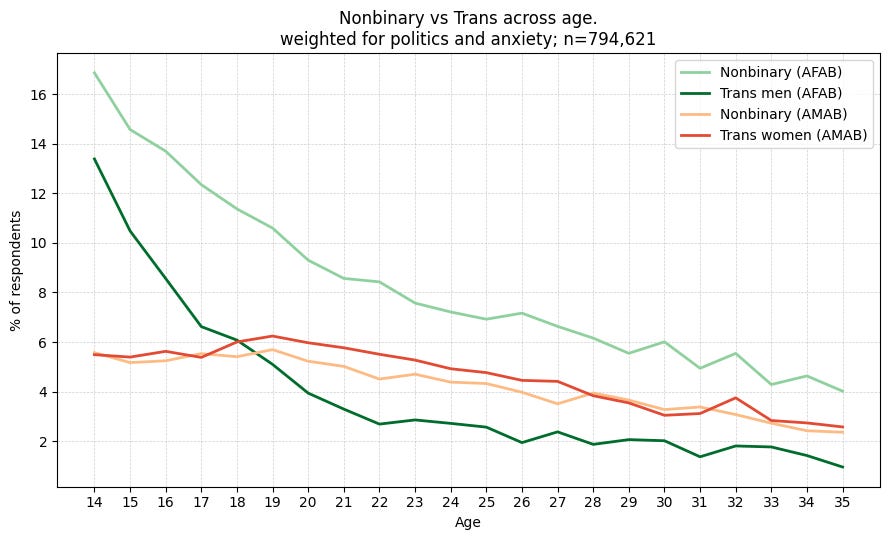
Among college-aged people, I find nonbinary rates of roughly 7%2 - at the higher end of the the Heterodox report, at the peak of their measured years.
You might also notice that I’m looking at age stratification, not ‘year the survey answer came in’. This is important - I’ve been running my survey for 3 years, and most of the responses have come in over the past 2 years. A 21 year old who answered my survey 2 years ago will have their data lumped in with a 19 year old who answered my survey this month.
(I also don’t want to stratify my own survey by time, because data has come in from different places on the internet at different times and controlling for this would be more complicated than I want to handle right now. I’m accepting a 2-year blur as the cost)
But let’s look a little more precisely:
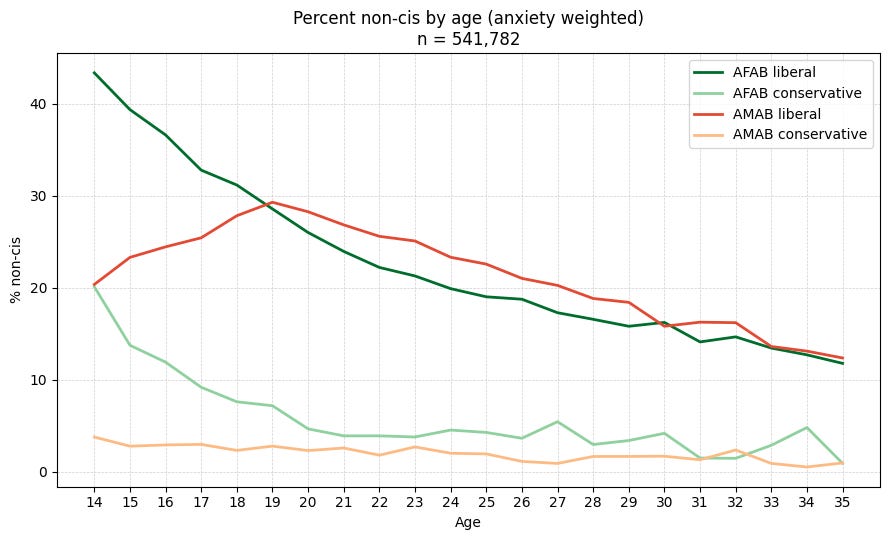
In my data, the decline in non-cis identification is happening exclusively in liberal males. Interestingly, we’re starting to see an uptick in non-cis identification among young conservative females! What is going on??
I think this is evidence for an increasing split between afabs and amabs, even within and separate from politics. We’re moving towards a world where identifying as non-cis gives us more information about your biological sex than it does about your political orientation.
I think the relative rates by demographic and change over age are less likely to be artifacts of selection bias, but I’m less certain about the absolute rates
Like, why do the college surveys show lower non-cis rates than mine? I have a lot of thoughts on this, but one very simple explanation is that I advertise a kink survey, and kinky people tend to be more non-cis, even adjusting for politics and anxiety (why I adjust on anxiety is another post coming up later).
My adjusted trans rates (~7% for high schoolers) are still higher than most normal surveys; e.g. the 2023 CDC survey where they get high schoolers to take it (anonymously filled out on paper or on computer, with a proctor in the room but presumably not looking at their answers) says ~3.3% of high schoolers identified as trans, and 2.2% said maybe-trans-not-sure-yet. If we assume this means 4.4% trans, and assume that rates have risen in the last year or two, and assume that trans students underreport when answering proctored surveys in person, then the gap looks less weird. But still, probably at least some of the difference is “trans people are kinkier, and kinkier people are more likely to take my survey.” If I had to balance the biases between both surveys, I’d estimate the ‘true’ self-reported trans rate in 2025 at something like… 5.4% (23% lower than my survey finds).
Despite having been cancelled by the more radical subgroups of trans people, I’m nevertheless very pro trans. People having weird, misunderstood brains, wanting to do unconventional stuff to their own bodies, violating a bunch of traditional expectations for how gender is supposed to operate? Exactly my schtick. I’ll happily break myself on the wheel of public opinion defending that stuff.
And so I’ve been pretty skeptical of the ‘people are turning our kids trans with propaganda’ train. I think there’s many cases where someone’s life would be way better off if they were allowed permanent gender reassignment stuff as a minor, and the tragedy is not the assignment itself, but that we don’t yet know how to separate these people from those who would be harmed.
I’ve assumed that most of the surge in non-cis identification is mostly females being nonbinary, which is… kinda low stakes? Like it’s a harmless way for afabs to disidentify with their gender, and if they ever change their mind they can just grow their hair out again or whatever. Let people express themselves it’s not a big deal geez.
But fifteen percent of 14-year-old afabs identifying as trans men is worrying to me. If we assume the real number is 23% lower (just an estimate, remember), this is still ~11.5% of 14-year-old afabs identifying as trans men.
I think it’s unlikely that 11.5% of afabs are actually trans men in a way that would last through adulthood. If my data is measuring any real trend in the world, and if that trend meaningfully increases permanent changes to bodies, then this high percentage might actually be quite bad.
(I also lament that this makes things really rough for the trans men for whom this is not a fad, and for whom earlier transitioning would be a huge quality of life improvement.)
In general, if my data is robust at all - and I think in terms of comparison between demographics it is probably pretty robust - I view this as worrying evidence for increased conflict between the sexes. Birth rates are down, relationships are fading, political polarization is increasingly gendered, and I do not think any of this bodes well.
There’s two lines of exploration I want to pursue from here.
The reason I’m controlling for anxiety is tied to a specific psychological subtype of females that I suspect might be growing, and a really unusual cluster of traits that keeps popping up correlated in my data (did you know that females who report that they are currently ovulating, report higher rates of being abused in childhood?)
Why are we seeing increasing differences in culture between males and females in recent years, given we’re at possibly the most gender-equitable time ever seen in human history? I actually think this is downstream of the psychology of status, and uh think the answer might be extremely politically incorrect but I guess that’s why we’re all here so yolo.
I’ll explore these more in future posts!
I weighted the sample by equally weighting 14 bins - each of the 7 social-politics bins from -3 (very conservative) to 3 (very liberal), crossed with amab and afab. This probably isn’t reflective of a true distribution of the population, as for example afabs are more liberal and amabs more conservative, but figuring out the exact political distribution in a way that could map onto my own survey question phrasings accurately seemed quite delicate, and more than I had time to do for this post.
I’m not including confidence intervals because idk if there’s a decent way to do them when you’re using just weighted averages. You can probably do them if you’re resampling the raw data itself, but I didn’t want to resample and when I plotted CI on the original data it wasn’t too broad anyway. My sample is so big that a lot of the best practices around error margins and whatever are less important (and you can sort of get a sense for the error margins by looking at the level of noise in the averaged chart) so I’ve gotten less anal about it over time.
To take a step back, people identifying moving from nonbinary / trans identities to cis identities isn't necessarily a concern. In the trans community, there's a tongue-in-cheek meme called "cis+", but the central premise is that people shouldn't feel bad for questioning their gender and coming out of that with a stronger understanding of their identity (likened to unlocking a new level of cis). You don't have to be trans to experiment with gender, and it's possible many "cis+" people bring elements from their exploratory phase into their new (final?) identity.
Anecdotally, all the "cis+" people I know have done something like this, separating a typically-gendered element from the concept of gender (e.g. men wearing makeup, women wearing binders).
Edit: Minor details
Aella, I’m a big fan of your surveys—I even used your public data to look at rates of paraphilic interests (thehumanconditionrevisited.substack.com/p/how-unusual-are-unusual-fantasies).
In my opinion, comparing age stratification to change over time doesn’t really work because they’re asking different questions. Age stratification shows how different age groups compare at a single time—for example, whether 16-year-olds differ from 30-year-olds right now. Change over time looks at how the overall population shifts across multiple time points. An age-based difference at one point doesn’t tell you how attitudes or behaviors are trending over time, and a trend over time doesn’t prove that one age group is driving it. So the two analyses can’t really be used to confirm or refute each other.
Also, the small uptick you mentioned in one age group hasn’t been tested for statistical significance, and there’s no margin of error reported. Without that, it’s impossible to know whether the difference is meaningful or just sampling noise.
That said, I also have doubts about the representativeness of Erik Kaufmann’s data. A lot of the attention it received seems driven more by political confirmation bias than real informative value.