
How To Cancel Someone
a guide for doing it politely

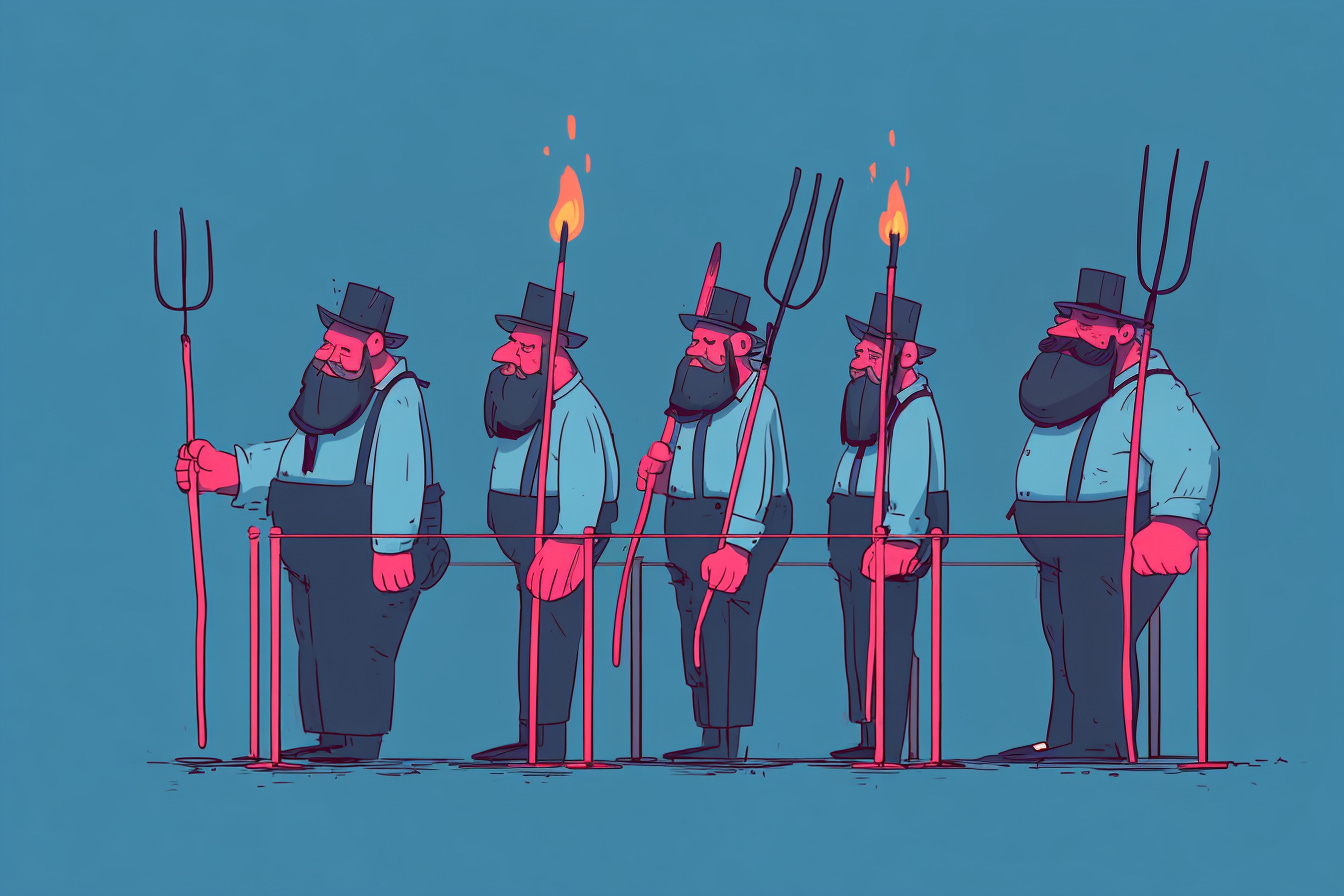
In the world of cancellations, people are often incompetent. If you’re going to cancel someone, you should do with all the strength of a raging fire, mysterious as the dark side of the moon.
I’m experienced in cancellations, having thrown my weight behind a few myself. I’ve also had many cancellation attempts thrust upon me, with varying degrees of success. I fought in the great woke wars of the early 20s, where bretheren fell under the swords of social exclusion right and left. So I come to you, battle-hardened, to help you learn how to do it right.
Cancellation is an attempt to chop someone’s status off at the knees. We do this because of a cultural agreement that this person has violated the rules that come with their associated power, and we are now terminating their contract.
Sometimes this is good. You can have them in the form of deposing kings: Jeffrey Epstein had a lot of power that touched a lot of domains, and he did not use it for good. It makes sense that an appropriate cancellation would have to be swift, fierce, and wide-reaching. Many cancellations are less about specific kings and more about socially executing flagbearers for dangerous memes; nazism killed a lot of innocents, and so we are happy to cancel small nazi flagbearers to prevent them from becoming big nazi flagbearers.
But most of the time, cancelling itself is where we negotiate our collective concept of ‘harm’. If the CEO of a huge corporation were caught saying “maybe we should imprison gay people to prevent their degeneracy from corrupting our children”, I would support their cancellation today - but fifty years ago I’d be an insane trigger-happy liberal radical for the same view. By the same rules, would I now try to cancel every public figure that eats meat, if I knew in fifty years we’d look back on meat consumption as a grand horror? Probably not!
And of course, we watched the political left go on a mass cancellation spree over the last several years, claiming victims such as James Damore and Justine Sacco or Lindsay Shepherd, in a magnitude rivaled only recently by the political right.
There is a great gulf of cancellations between Jeffrey Epstein and James Damore, but in general I lean towards cancelling less. It’s easy to say your cancellation is about ‘preventing harm’, while your definition of ‘harm’ quietly slips past credulity. I think we should all be more suspicious of ourselves and more charitable to others. Cancelling is social violence, and we should use it as a last resort.
So, let’s say you want to cancel Bob. First ask yourself:
Does Bob pose a concrete threat? Is Bob meaningfully responsible for direct harm to others?
Does or did the harm directly remove or limit agency from the victim somehow? e.g. ‘being offended’ is usually not agency-limiting in a way that ‘having safewords ignored’ is.
Do Bob’s victims generalize? Is their psyche common enough in the population that more of this class are likely to run into Bob?
And if they do run into Bob, is he meaningfully likely to offend against them again? If so, can you explain a very concrete scenario you’re afraid of happening?
Are the accusations against Bob from credible sources? Are you willing to entertain the possibility the sources might not be credible?
Would your cancellation of Bob remove his capacity to harm others?
Are there no other options? Have people already tried talking to Bob? Has someone already made an serious attempt to handle this privately, such that you have reason to believe Bob is unlikely to change?
If doing this on behalf of someone else, check if you’re credible enough. Are you trustworthy? If you tend to be confused by why your past relationships keep exploding dramatically, or why communities keep banning you from events, then you might not be the right person to fill this role unless there’s no other option.
If your answer to all of these is ‘yes’, then it’s probably a good idea to cancel Bob.
I mean this in like, big-C “write up a big post about Bob, warn people considering working/dating them, ban them from the meetup” type cancel. I think smaller-scale, private social-circle stuff can sometimes be justified on less stringent criteria, but I’m not talking about that here.
Let’s imagine his offense is taking hidden camera bathroom videos of an ex and uploading them to porn sites, and his actions fit all the criteria above.
Here we go:
State the facts.
Make sure you report the facts themselves as neutrally and as accurately as possible. State them without aggressive language. “Last week, Alice shared with me a screenshot of Bob’s account posting this video to a porn site.”
and include important factual context that opposed parties might agree is relevant. “Alice did at one point agree to take nudes and expressed comfort with showing them publicly, although she never consented to the currently shared photos.”
If including quotes from others, include their hedges as to not mislead people about their full, nuanced opinion. e.g. don’t crop out the last sentence when Bob says: “She doesn’t deserve privacy. Hiding bad actions from others is nothing you should be private about.'“
Do not make factual claims about others’ intentions, unless they directly stated those intentions. You can state what they did, and say “this seems consistent with an intention to x” or “it seems likely their goal was to y”, but do not assume what’s going on in someone else’s head.
The ‘clean facts’ part is important because you should not be playing dirty. It is possible for different people to observe the same reality and come to different conclusions; you should not be trying to force conclusions on people, but rather to try to help them observe reality and hope that their conclusions are similar to yours. If you’re making an undeserved cancellation, you should cancel in a way that will result in your own failure. If you’ve gotten a fact wrong, or if the facts aren’t as strong as is justified, then your transparency should backfire on you. This is good and correct. It is much better to make a weak, true case, than to make a strong muddled one. Cancel others as you yourself would want to be cancelled.
Make sure your interpretations are your interpretations. “This is bad” or “Bob was trying to be cruel to Alice” should be clearly labeled as yours, not as absolute claims about the state of the world. A simple “I think that” or “my guess is” goes a long way.
Be emotional, but in a constrained space. Somewhere other than the facts, and your interpetations, you should have at least some communication about your emotional relationship to all of this. Are you furious? Shaking? Disappointed? It’s good to know what it means to you, the lens through which this whole thing comes. It helps us interpret what you’re saying, and also helps us understand the impact of what Bob may have done. It’s also honest! It’s a true fact about reality! It’s important to know!
If the situation is complicated, anticipate misunderstandings from those who may become furious at Bob, and correct them. “I am not pretending Bob was terrible the entire relationship. Bob has a lot of good qualities and, in his mind, probably believed he was doing something righteous.”
It’s okay for conflicting things to both be true, like both wanting to cancel Bob and being sad Bob is getting cancelled. Don’t shy away from naming one thing just because it seems to go against the narrative of something else.
Don’t demonize Bob with villanous language. Your goal here is to let people know that someone habitually engages in dangerous behavior so they can protect themselves and others. Your goal is not to punish or torture. You do not want to turn this into tribal warfare. You should be a small, cold, precise knife that flicks in and out and is done.
Be reasonably sure about your rumors, which are often less true and more warped than you think. You should check if the people telling you stories might have any ulterior motives, or if you’ve noticed them distort things in the past. Don’t be afraid to ask for proof. This can be hard, especially if they are your friends.
Don’t name accomplices you are not also willing to cancel under the same criteria as Bob.
Communicate, as concretely as possible, the damage done by Bob. Was someone physically harmed? Does Alice now have nightmares?
Give concrete suggestions for what you think the readers should do. Should there be a tribunal to rehabilitate Bob? Should you get the police involved? Should Bob not be allowed into certain buildings anymore? Should people contact Bob’s employers to try to fire him? Are you personally going to change your behavior around Bob at all?
Making a complaint common knowledge and trying to call a lot of people to action to exclude someone is a big deal, and should be treated pretty carefully.
But to repeat, I think there’s lower standards for lesser verisons of this. If your ex tends to cheat on people, you maybe don’t need to make a big writeup with his full legal name demaning he be barred from his industry, but rather can whisper network the facts of it to other women in your community. My post here is not about how to execute whisper networks well, that’s a whole different and much murkier thing.
A few more points:
Be wary about agreeing to secrets. Do not do this compulsively or automatically. It’s a good idea to have a policy of waiting for a full hour no matter what before saying ‘yes’ to a secret. It can be awful to simultaneously have bad information about someone and be completely forbidden from investigating it further, or being able to explain why you’re now e.g. uninviting someone from your party. I’m not saying you should never agree to secrets, only be aware that bad actors can request your secrecy in a way that can hurt people they’re targeting.
In general, the whole thing is going to be uncomfortable for everybody - those with information, witnesses, victims, you yourself. People will try to keep themselves clean of any social repercussions (e.g. by remaining anonymous), but some amount of absolute social repercussion will accrue no matter what, and if you allow them to refuse all of it it will end up piling on you. If someone has power, and you are the only one willing to speak out on behalf of many anonymous people, the wrath will fall on you alone. This often isn’t sustainable; it’s okay to agree to help victims only on the condition that they share some of the load. It’s also okay not to! Just make sure you are aware of the costs before you agree to them.
I disadvise second-order cancellations, where you publicly shun people who associate with the cancelled person. That should be more of a case-by-case, personal whisper network type thing, not a public call. If you do want to cancel someone still associating with a Cancelled person, you should make sure that person qualifies for Cancellation on their own, independently - has that person caused concrete harm to a victim? etc.
The problem with most cancellations is that they fall into righteousness, overreach, and an attempt to coerce the reader into a conclusion instead of respecting different interpretations. This feels right when you’re angry, but many terrible things have been done by very angry people who thought they were doing the right thing. You must act under the same set of rules that would protect you yourself from bad people!
I don't really know your intended audience but I think this is greatly misguided.
Why should there be mob justice in the first place? If you don't want to invite anyone to a party you can do that with no public explanation and even no explanation to them.
If the behavior is criminal, there is normal justice with proper safeguards.
If the behavior is simply distateful in a social bubble, no need to smear them; again you can simply exclude who you want from your friendship no justifications needed.
"Cancel others as you yourself would want to be cancelled" -> exactly, so no cancellations at all.
Maybe because I expect I could be cancelled only by angry righteous misguided people because I don't expect to act malignantly.
Anyway, let's have free speech (no defamations) not cancellations for what one thinks. Which is what usually happens, not about what one DID but what one believes.
TL;DR cancellations are a virtual form of lynching, which often has also very material consequences. Lynching is always bad and having a guide to politely do something bad sounds very weird (even for you :P).
Cancel culture is just a bureaucracy of righteousness.
It always starts the same way: “I’m not power-hungry, I’m just enforcing the rules.” Every inquisitor in history said that. So did every censor. So did every regime that sincerely believed it was saving society from harm.
Your essay tries to civilise cancellation by giving it a checklist, as if social execution becomes ethical once it’s properly documented. It doesn’t. You’ve simply replaced pitchforks with Google Docs.
You claim cancellation is a last resort, yet you normalise it as a routine tool for enforcing today’s moral fashion, fully aware that yesterday’s heresy often becomes tomorrow’s orthodoxy. That alone should disqualify anyone from acting as judge, jury, and amplifier.
The core flaw is simple: you confuse moral certainty with moral authority. Feeling righteous does not make you right. Being convinced you’re preventing harm does not mean you are. History is crowded with people who were absolutely sure—and catastrophically wrong.
Your rules don’t restrain power; they launder it. They let ordinary people cosplay as executioners while insisting they’re being careful, fair, and sad about it. That’s not humility. That’s self-deception with footnotes.
If your system requires people to publicly destroy others “carefully,” the system is the problem—not the technique.
Real justice uses restraint, due process, and proportionality.
Cancellation uses vibes, momentum, and applause.
One of those survives contact with time. The other never does.