
Birth Control Myths Vs Data
Does birth control impact depression, sex drive, or preference for masculinity?

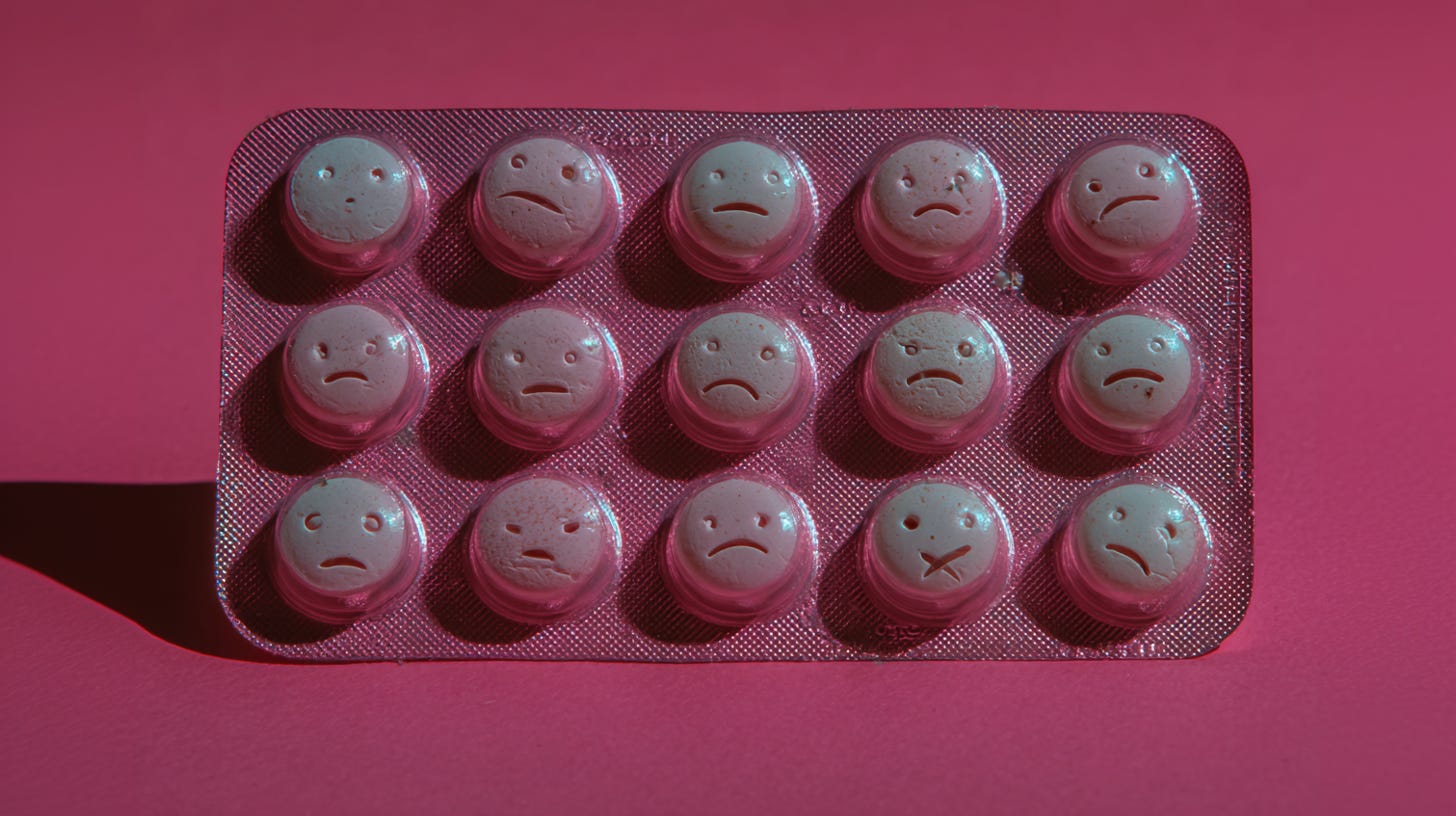
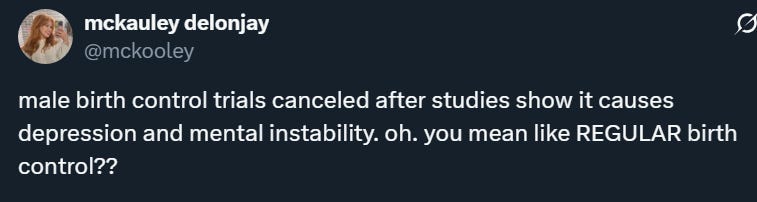
I’ve heard lots of women report that hormonal birth control impacts them quite a lot. The three claims I’ve heard most are that it:
Causes depression
Reduces sex drive


Reduces attraction to men and masculinity (increased preference for femininity and women)






Is this true?
I asked ~47,800 cis women if they were on hormonal birth control or not. For a simple attempt to ‘control’ for important demographics that might confound our results, I took out a slice of women who were: in a relationship, not gay, 18-26yo, and living in the US, Canada, or a western European country.
This left ~9,300 women, or 19% of my original sample.
I also asked them a whole bunch of other questions. This is from my Big Kink Survey, a giant viral survey I built with a total sample of ~850k. I added in ‘are you on hormonal birth control’ late, so the sample for this is much lower. The people in this sample are almost entirely not my followers.
Depression
Alright, let’s look at depression. I asked people to check off any illnesses they had from a list of illnesses. Do a higher percentage of people on birth control report being depressed?
Yes, a 5% difference. 45% of women not on hormonal bc reported depression, while 50% of women on hormonal bc reported depression.
(This within-slice, and after being adjusted for politics (MH method), as liberal women are more depressed and also more on birth control). P-values are extremely tiny.
The 5% gap isn’t huge, and it’s possible it’s due to some confounding I haven’t thought of, but it still is surprising to me and updates me towards a world where hormonal birth control causes depression.
But what about other mental illnesses?
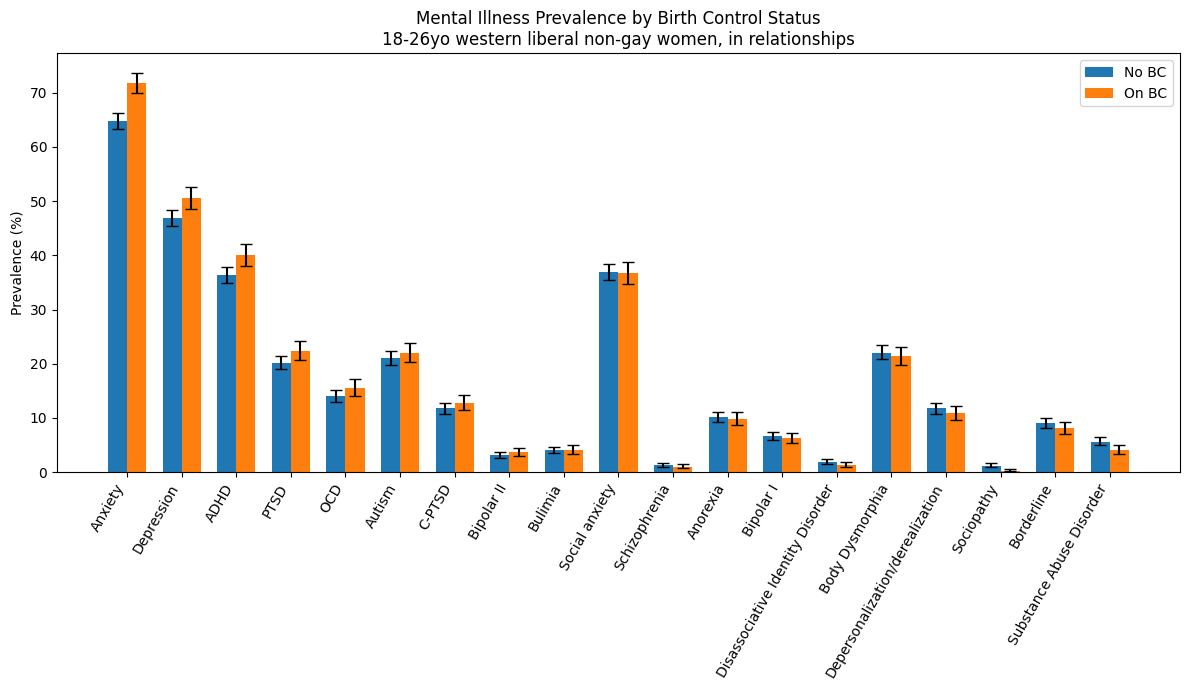
Interestingly, anxiety is the most pronounced gap (6.5%) here.
And of course, the causality is unclear. Do more anxious, depressed women tend to go on hormonal birth control, or does birth control cause women to be more anxious and depressed? Is this correlated with sex drive - the higher sex drive and promiscuity, the greater the need for birth control, but also the greater association with negative mental health?
Still, I count this as a chunk of evidence in favor of the birth control mythology.
Conventional Wisdom: 1, Skepticism: 0
Reduces sex drive
I also added in a question asking people how horny they were right now, and also how horny they’ve been in the last 24 hours. If hormonal birth control suppresses sex drive, we’d probably see some effect here.
I unfortunately added these questions pretty late, so my sample size for my filtered slice is only 2,127. That’s still bigger than almost all published survey-based papers in this field though so let’s look anyway.
37.3% of women not on birth control reported being at least moderately horny right now.
44.8% of women on birth control reported being moderately horny right now.
Gap of 7.5%! (z=-3.3, p=0.0009)
We see similar effects for “how horny have you been in the last 24 hours?”, at 66% vs 71.5% (z=-2.6, p=0.01)

This seems like a real result to me. I can’t think of any obvious confounders that might be throwing these numbers; when I fiddle around with my slice (like looking at people in different levels of seriousness of relationship) the effect is still there. Politics doesn’t affect it either; when I look only at liberals the difference actually increases.
Who knows about causality - are hornier people having more sex and thus more likely to go on birth control?
Let’s check on my earlier guess that sex drive is correlated with anxiety, using ‘are you horny right now/in last 24 hours’ as a proxy:
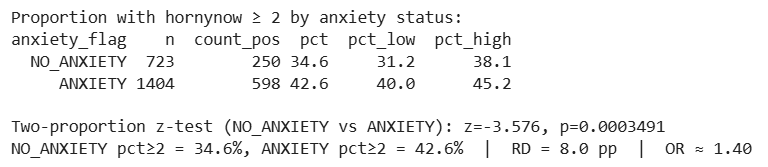
Huh, an 8% difference. Women who say they’re hornier, are more likely to say they’re anxious (5.2% for the 24 hour question).
What, uh, is going on?
The trend holds for depression (9.3% diff), ADHD (6.1%), PTSD (13.3%), C-PTSD (13.1%), OCD (3.2%), autism (3.2%)…
Here’s all of them:
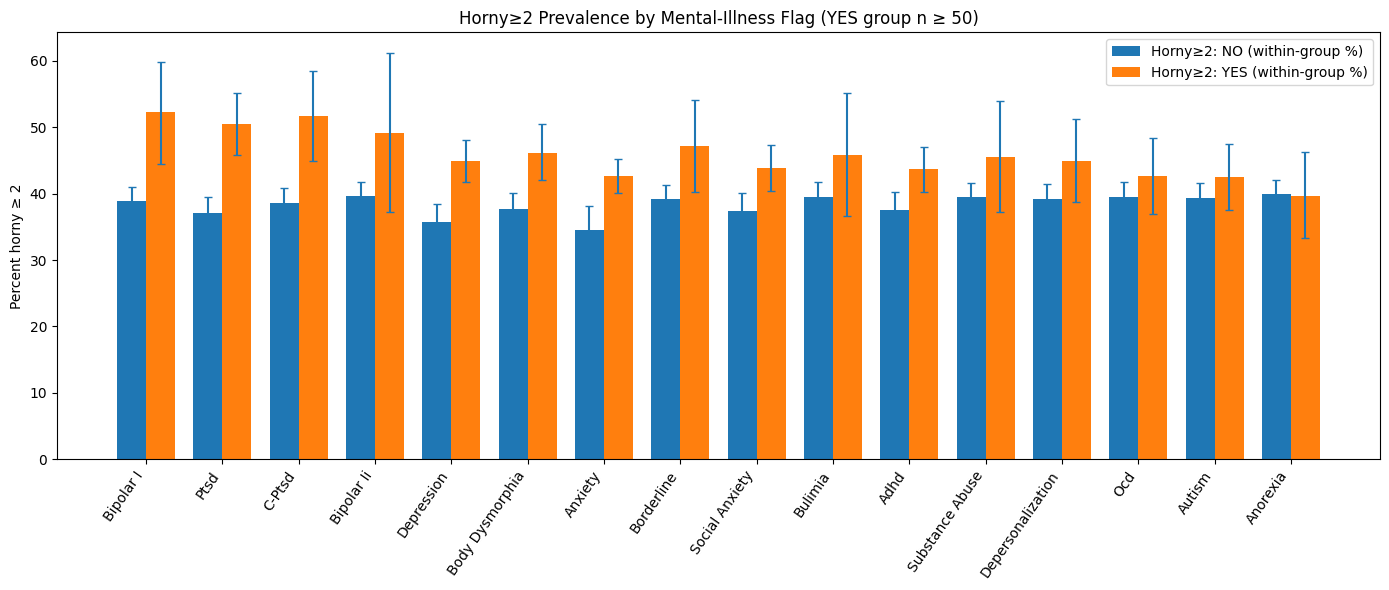
Out of all mental illnesses I asked about, the only one that non-horny women reported having more of was anorexia, and even then only by a tiny hair.
I… have a suspicion. Let me check something else
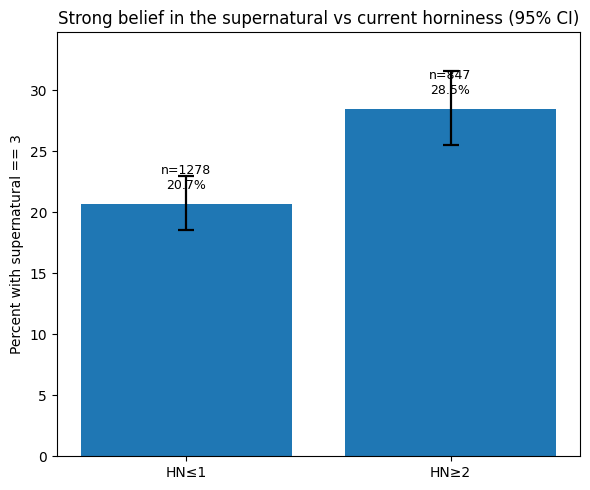
Of women who answered less than ‘moderately horny’, 21% reported strong belief in the supernatural. Of women who said they were at least moderately horny, 28.5% reported strong belief.
Interesting. This is starting to bite into a different blogpost I have planned, so I’ll leave it here for now, but there is something weird going on.
Still - it seems that women on birth control say they’re hornier, which is counter the birth control mythology.
Conventional Wisdom: 1, Skepticism: 1
Impact on attraction to masculinity
I asked people “You’re more sexually attracted to people who appear visually-” and then gave them a spectrum from ‘totally masculine’ to ‘totally feminine’.
To keep this simple, let’s see - what % of women said at least ‘moderately masculine’, and did this differ based on birth control usage?
Off birth control: 59.6%
On birth control: 62.2%
Not a huge difference, but the difference that exists is counter the myth.
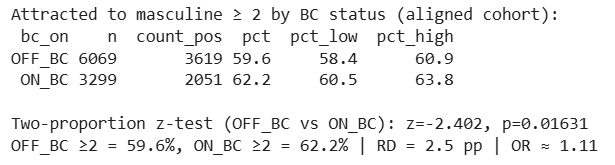
I’d wonder if it’s confounded by liberalism, but liberals are more likely to both be on birth control, and prefer femininity. If anything the pressure should be in the opposite direction.
Looking only at liberals, we get 48.7% vs 52.5%; more liberals on birth control still prefer masculine men.
Of course this is self-reports, which means maybe something else is influencing the outcome. It’s not obvious what could be - I’m only looking at people inside relationships, for example, so we’re filtering out an effect that would come from women who aren’t in relationships (less likely to be into masculinity?) and also are less likely to be on birth control.
There’s almost no difference in dominance/submission and hormonal birth control; 1.6% more women on hormonal birth control reported being submissive, while 1.5% fewer women on birth control reported being dominant. Tiny.
(As a quick aside, I asked if they got mood-based pms symptoms during their menstrual cycle. 47.1% of people on birth control said at least moderately yes, while 52.7% of people not on birth control said the same. I didn’t expect this answer!)
Other academic research seems to agree with me here; a quick glance at the findings and I’m under the impression that there’s mixed results, mostly among research with very small sample sizes. One study I’ve seen cited a lot is where they gave some women pills and some not-pills, and had them sniff shirts. The study itself is cool and well constructed, but it’s not about masculinity but rather about genetic similarity, and even then they didn’t actually find any effect, and then reran the analysis with a smaller subsample (!!!!) until they got a tiny effect, and even then the tiny effect was after measuring a bunch of things so it’s almost certainly p-hacking.
So I’m gonna call this myth busted - no, birth control probably doesn’t have an impact on masculine vs feminine men.
Conventional Wisdom: 1, Skepticism: 2
So wait - why does the conventional wisdom exist?
“Conventional wisdom” is different in different regions of the world. In Egypt they believe it causes cancer; in Southeast Asia they believe it causes menstrual blood to back up; in sub-Saharan Africa they think it reduces fertility.
Part of it is probably psychosomatic. I’ve been doing egg freezing, and I’d heard people talk about how the increased estrogen makes you real horny or whatever. Lo and behold, my first freezing round I experienced a much higher sex drive! But afterwards I felt suspicious and wondered how much of it was just me psyching myself out, and my next three rounds featured no change in arousal. Sex drive specifically seems really responsive to placebo.
But also, deciding to go on or off birth control probably correlates with other stuff going on in your life. Break up with a guy, go off birth control, suddenly feel horny and into chads? It’s probably the breakup, not the birth control. Wife of 15 years goes off birth control because she’s nearing menopause? Hm, I wonder if it could be the menopause.
And lastly, it’s easy to overfit natural changes. If something subtle affects your preference for masculinity - maybe a shift in your friend group - and this happens to coincide with a change in birth control, you’ll be much more likely to identify the birth control as causal because you’ve been exposed to the memes about how it’s supposed to be causal. It’s easy to find patterns once you look for them, and we don’t notice all the trends that don’t fit, because we don’t look for them.
My survey results are far from definitive; despite looking at a very heterogeneous sample, it’s still possible there’s some other secret confounder in there I haven’t figured out.
Still though - based on the way people talk about birth control, I’d expect to see something like a 15% jump minimum in stuff like masc preference, sex drive, and yes - also depression. People just don’t tend to organically notice small difference between groups. While I did see a 5% higher rate of depression/anxiety in birth control users, I suspect still that most of what people are seeing is still not real. 5% just isn’t that big.
I doubt a mystery confounder is managing to hide an effect large enough to explain the conventional wisdom. My next goal is to measure the differences between women who believe that birth control affects these things, vs women who don’t, to see if that gives us any further clues.
Reminder that I’m running Slutcon, Oct 10-12. We still have earlybird prices on the most accessible ticket, if any of you wanted to grab one before the price jumps <3
Did you happen to ask if they were using an IUD? That would be an interesting cohort to restrict comparison to.
Different kinds of birth control - even different pills - have had very different effects on me. Mostly a tradeoff between psych effects and effectiveness at reducing cramps and flow.
I'd expect from my experience that some birth control pills have dramatic effects on some people (although the adverse effect I really couldn't live with was increased anger and tendency to violence, my baseline for PMS was already suicidal depression and basically any pill made this less pronounced) but most people then shop around and find a birth control that has effects they can live with, which will be less than the worst case effects.